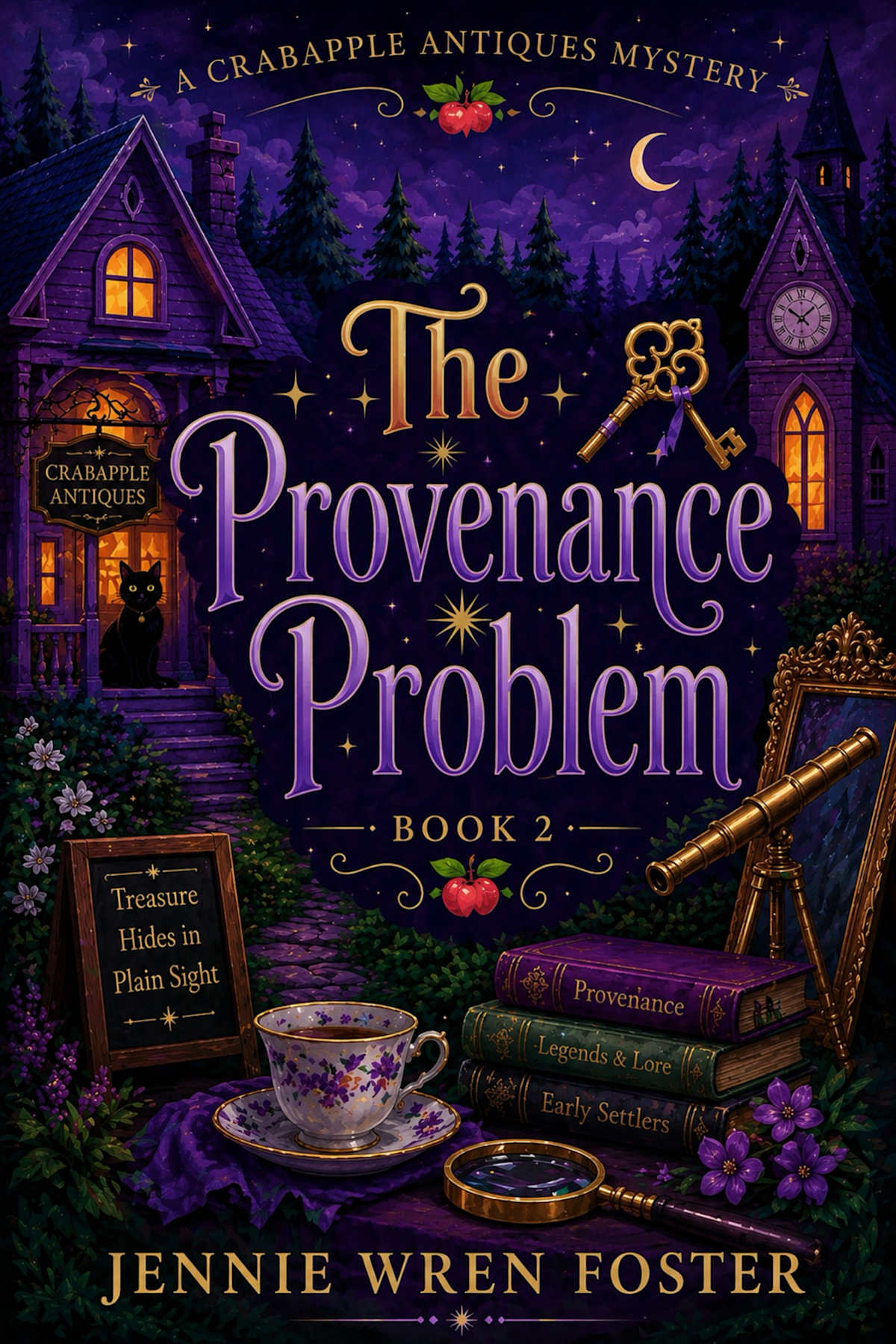
WHAT THE DESK REMEMBERS A Crabapple Antiques Mysteries bonus story Jennie Wren Foster
Kettlebrook, Vermont — October 1966
I have been an archivist for thirty-one years, and the first thing they teach you, if anyone teaches you at all, which they did not teach me, is that a record is only as safe as the person willing to keep it.
I learned that the hard way, the way I have learned everything. You would think, given the work, that I would have a horror of fire, of flood, of the slow brown rot that takes paper the way age takes the rest of us. I do fear those. But the thing I have come to fear most, in thirty-one years of keeping this town’s memory in two attached rooms behind the Town Hall, is people. Kind people. Comfortable people. The ones who would never burn a document, who would simply decline to look at it, and decline to let you look at it, and smile at you very pleasantly in the post office while the truth sits in a folder going quietly to dust because no one was brave enough to enter it into the record.
I found the deed in September.
I will not write here what it was. If you are reading this, you may already know, or you may know someday, and either way the writing of it is the dangerous part, which is rather the whole point of what I am about to do. I found it folded into the wrong file, the way the most important things always hide, not locked away but misfiled, sitting in plain and patient wrongness for eighty years because no one had thought to ask why a wood-lot sale was three pages longer than a wood-lot sale should be. I unfolded the extra pages at my desk on a Tuesday afternoon with the light going amber through the west window, and I read them twice, and then I sat very still for a long time, because I understood at once that I had just become a problem.
A town’s whole shape rests on certain papers. Who owns the green. Who owns the mill. Who has been collecting rent, for eighty years, on land that the earlier page in my hands said had been held in common, in trust, for everyone. I am an archivist. I deal in the difference between what is recorded and what is true, and I had just found a place where the two had been deliberately pried apart and a forgery slid into the gap, and the family that benefited from the prying was the oldest, kindest, most beloved family in this county.
I told the board I would present my findings on Friday. I see now that this was a mistake. I made it because I believed, as I have believed my whole life, that the record is a kind of safety, that a thing written down and announced becomes harder to bury. I had the order exactly backward. Announcing it did not make it safe. It only told the family which Friday they had until.
So tonight I am doing the unprofessional thing.
It is past nine. The reading room is dark except for my lamp, the good brass one with the green shade, and the building has gone to its evening sounds, the radiator’s knock, the settle of old beams, the particular hush a room of paper holds. I have made two copies of the relevant pages in my own hand. The original I am hiding tonight, in the place I have chosen, which I will not name even here. The copies I am dividing, because my grandmother taught me that you never keep the whole of anything that matters in a single drawer, and because I am, underneath the cardigan and the spectacles and the thirty-one years, a deeply suspicious woman, and it is the only quality of mine I would not trade.
But paper can be found. Paper can be smoothed flat, declined, misfiled by a less honest hand than mine. I have spent my whole life trusting paper, and tonight, for the first time, I do not trust it enough.
So I am trusting the furniture instead.
You will think I have lost my reason. I have not. I have lived in Kettlebrook all my life, and in Kettlebrook everyone knows what everyone refuses to discuss, which is that the things in this town are not always only things. The hardware man reads rain in his metal. The Pelletier girl finds water with a bent wire and a frown. And I have sat at this desk for thirty-one years, and I have come, slowly, to understand that it has been sitting with me. That a thing which is present for enough years, handled with enough attention, asked enough questions, begins, in some way I cannot record and would not try to, to hold what it has witnessed.
I cannot wake it. I have no gift for that. I am only a woman with good penmanship and a bad fear of heights and a deed that someone will kill to bury. But I can do the one thing I am good at, which is to keep a record where the wrong hands cannot read it. And there is no safer record in the world than a witness that cannot be opened by anyone who does not already know how to ask.
So I am giving the desk the pointing piece. The fragment. The top of the true deed, the part that says look here, this is real, the rest exists. I am tucking it into the deep keeping behind the writing surface, the compartment I have never shown a living soul, and I am telling the desk, out loud, like the foolish old woman the town will say I was, what it is and why it matters and what it must hold until the right person comes.
“You keep this,” I tell it. The lamp gilds the walnut. The brass pull is warm under my hand, though that is surely only the lamp. “I cannot make you speak. But I can keep you here, in this town, with the others, and I can trust that Kettlebrook will someday grow a person who can ask you properly. You hold it until she does. However long. You have nothing but time, and I am running out of mine.”
The desk does nothing, in the way a thing does nothing when it has heard you. I have learned to read that stillness. It is the stillness of being understood.
I am not afraid, writing this, which surprises me.
I should be. I am not a brave woman. I have spent my life choosing the smaller, safer thing, the recorded thing, the question I was permitted to ask. I have a horror of heights so complete I have never once climbed the reading-room ladder, a fact this whole town knows and finds charming, the way they find me charming, the harmless spinster who keeps the cards in order.
I think it is possible that someone is going to use that against me. That the same town which knows I do not climb will be told that I climbed, and fell, late, alone, reaching for something I had no reason to reach for at an hour I had no reason to be reaching. And I think they will believe it, not because it is plausible but because it is comfortable, because the alternative is to ask which kind family stood to lose everything if I spoke on Friday, and nobody in this town will ask that question out loud.
So I am writing it down instead, here, in the last journal, in the deep keeping, beside the fragment, where the comfortable hands will never look. Not for them. For her. For whoever she is, the one this town will grow, in its own time, who will sit at this desk someday and be the kind of person who cannot let a thing that doesn’t add up simply lie there.
If you are reading this, then it worked. Then the desk kept faith longer than I could, and the town grew you after all, and you have asked it properly, and it has answered.
I did not fall. Remember that, whatever they wrote in the file. I did not fall.
I set this down freely, and I keep the record true, and I trust the only witness left that cannot be persuaded to forget.
The lamp is low. It is nearly half past nine. I can hear a car in the lot.
— M. V.
“What the Desk Remembers” is a free companion story to THE PROVENANCE PROBLEM, Book Two of the Crabapple Antiques Mysteries. For Addie’s side of the story — sixty years later — find the series at www.jenniewrenfosterauthor.com.