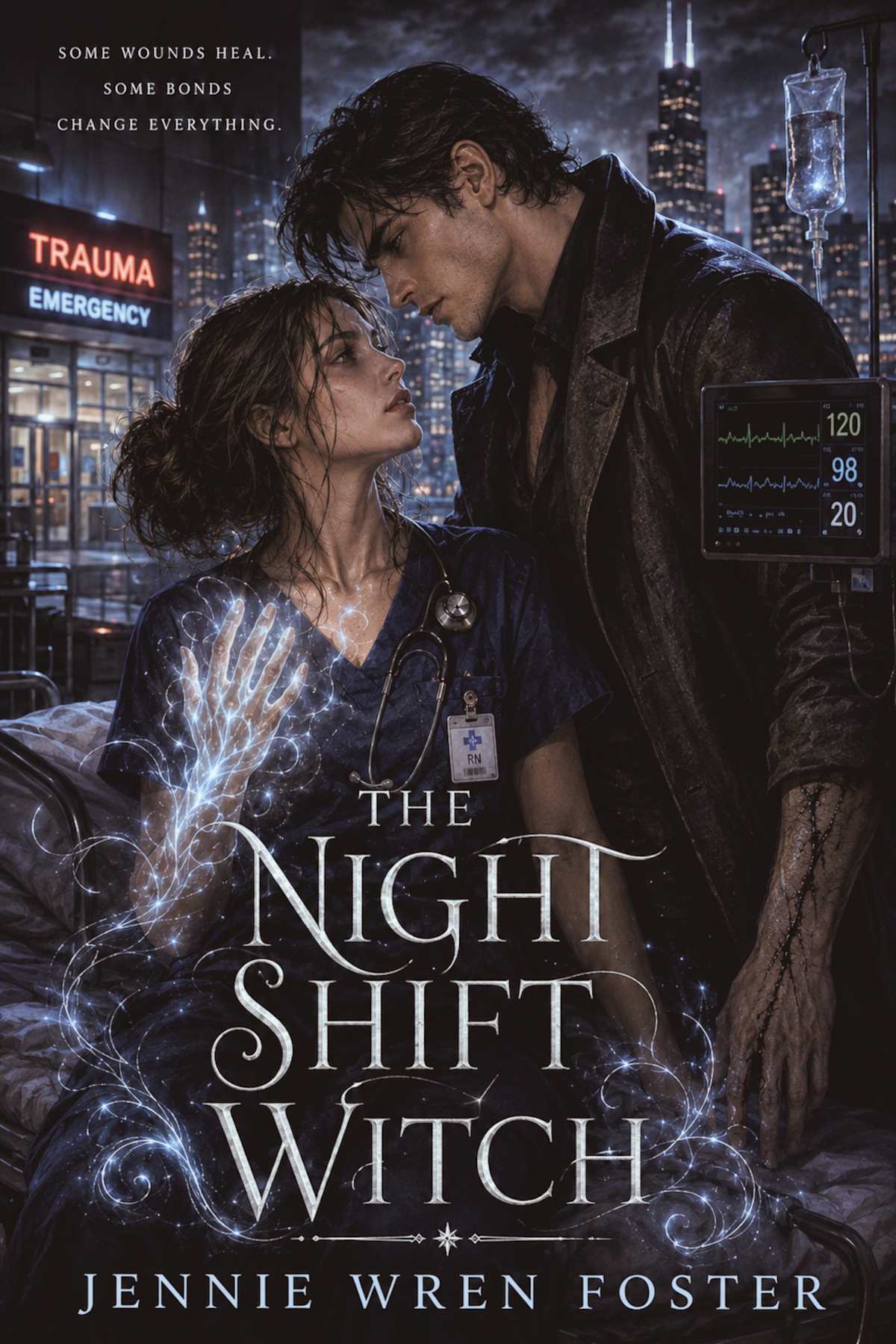
The Watcher
A Coven General bonus scene — Rourke’s POV
Free newsletter exclusive (~1,550 words). The first night, from the other side of the bond. Jennie Wren Foster.
I had been sent to confirm a rumor, and I did not expect the rumor to be tired.
That was the first thing I noticed about her, before the silver, before the rest of it: the woman in the pink scrubs was running on nothing. I have watched a great many humans over a great many years, and you learn to read the body the way you read weather — and hers said empty. Forty hours of caffeine and spite stacked on a frame that should have been asleep. She crossed the trauma bay like a woman wading upstream, and she did not once stop moving, and I thought, with the detachment I have spent a century perfecting: That one will burn out inside a year. They always do, the ones who can’t stop giving. It’s a kind of slow suicide with a parking permit.
I did not yet know how right I was. I did not yet know it would be the thing I loved most about her, or the thing that would nearly kill her, or that those would turn out to be the same thing.
Blackwood had heard what the rest of us had heard — that something old was stirring at County General, that a fae boy had been brought in bleeding silver and had not stayed dead the way he should have. She sent me because I am good at confirming things quietly. I am good at a great many things quietly. It is most of what two hundred years of careful will buy you: the ability to stand at the end of a fluorescent corridor and be, for all practical purposes, a coat someone forgot to take home.
So I stood at the end of the corridor, and I watched.
The boy died. I felt it go through the room — that particular cold drop when a thread in the world is cut. And then I felt something I had not felt in longer than I let myself count: a pull. The bright, impossible signature of a soul-weaver, lit up like a struck match in a dark house.
I had told myself, on the drive over, that the rumor would be nothing. A trick. A frightened fae. I had told myself this firmly, the way you press on a bruise to prove it doesn’t hurt.
It was not nothing. It was her, standing over a dead boy with her hands full of light, looking at her own palms like they belonged to a stranger — and the worst part, the part I have never told her, is that for one second I felt glad. Not strategic. Not useful. Glad, the way you are glad of a warm day you didn’t earn. I had been cold for a hundred years and did not know it until the sun put a hand on the back of my neck.
I should have left then. That would have been the wise thing — report the asset, let Blackwood’s machinery grind toward her, keep my careful distance from the one kind of person I had sworn never to stand near again. I have loved two soul-weavers in my long life. I held one of them while she burned. I learned the lesson. I had the scar to prove I’d learned it.
Then she turned and looked down the corridor and saw me.
And here is the thing nobody warns you about, the thing not in any of my careful rules: she was not afraid. Exhausted, yes. Hollowed out, yes. But she met my eyes the way you’d meet a difficult patient — what now, what fresh thing does the night want from me — and there was something in the set of her jaw that was less fear than inconvenience. As though I were one more item on a list she was too tired to be frightened of.
No one had looked at me like that in a hundred years. People look at me with hunger, or with terror, or with the practiced blankness of those who have learned what I am. They do not look at me like I am a parking ticket.
I left before she could say anything. I am not proud of the speed of it. I told myself it was discipline. It was not discipline. It was the oldest reflex there is — run, before this can cost you something — and I have spent the rest of the story unlearning it.
I went back, of course. You already know I went back. I have never once, in the whole of this, managed to do the wise thing where she’s concerned.
I told myself it was reconnaissance. Confirm the ability under controlled conditions, before Blackwood sent someone who would confirm it with a knife. I told myself the cut on my arm was convenient — a real wound, from real business, no need to manufacture one. I told myself I would be in and out, that I would feel nothing, that I would hand her a frightening fact and a head start and call it a debt repaid to two women a century dead.
I am, it turns out, an exceptional liar to everyone except her.
She came around the curtain with a clipboard held like a shield and absolutely no intention of being charmed, and she looked at me — at the bored magnificence I have spent decades perfecting, the stillness that empties most rooms — and she said, you’re doing a bit.
A bit. Two hundred years of carefully cultivated menace, and the woman diagnosed me in four words while reaching for a suture tray.
I should have been insulted. I was — I want to be honest in this, since she’ll never read it — I was delighted, in the appalled way you’re delighted when a thing you were sure you understood turns out to be entirely new. I had come to test her. I did not understand, yet, that the test had three questions and I was failing all of them. Can she heal me. Can she be controlled. Can I stand this close to a soul-weaver and keep my careful distance.
Yes. No. And — God help me — no.
When she put her hand to the wound, I felt the bond take. I have felt it before; I knew exactly what it would be, the cold thread snapping taut, a stranger installed at the edge of me. I braced for it the way you brace for a familiar grief.
It was not what I remembered. The other two — and I loved them, I did, in the thin careful way I had then — the other two felt like a door opening onto a cold room. This felt like a window in a house I’d assumed was condemned. Warmth I hadn’t authorized. And underneath my relief and my calculation and the smooth machinery of the lie I was telling her, something I had buried so deep I’d forgotten the shape of it stirred and said, quietly, oh.
She felt it. I know that now. I didn’t then — I thought I’d kept it behind the wall, the way I keep everything. But she felt the fear under the boredom, the old tired terror I have never once said out loud, and she made a decision in that exam room that I wouldn’t understand for weeks.
She decided not to tell me she could see it.
That is the most dangerous thing anyone has ever done to me. Not a blade. Not a queen. A tired woman in pink scrubs deciding, on no evidence and less sleep, to be gentle with the part of me I’d spent a century hiding — and saying nothing, so I’d never have to defend it.
I told her I’d come back in three nights. I told her to tell no one. I told her she looked like death, because it was true and because I needed, badly, to say something that wasn’t thank you or run or the third thing, the one I didn’t have words for yet.
Then I left, the way I leave, and I stood across the street under a lamppost like the coward I am about exactly one thing, and I watched her light come on in a third-floor window, and I did the math I am very good at and have always trusted.
The math said: walk away. She is a candle. You are the dark. You know how this ends.
For the first time in two hundred years, I checked the math twice, and then I did not listen to it.
I have a great deal of forever, and I have spent most of it being careful.
I was, it seemed, about to stop.
Want more? Catherine and Rourke return in Code Black, Coven General Book Two. Sign up at www.jenniewrenfosterauthor.com.