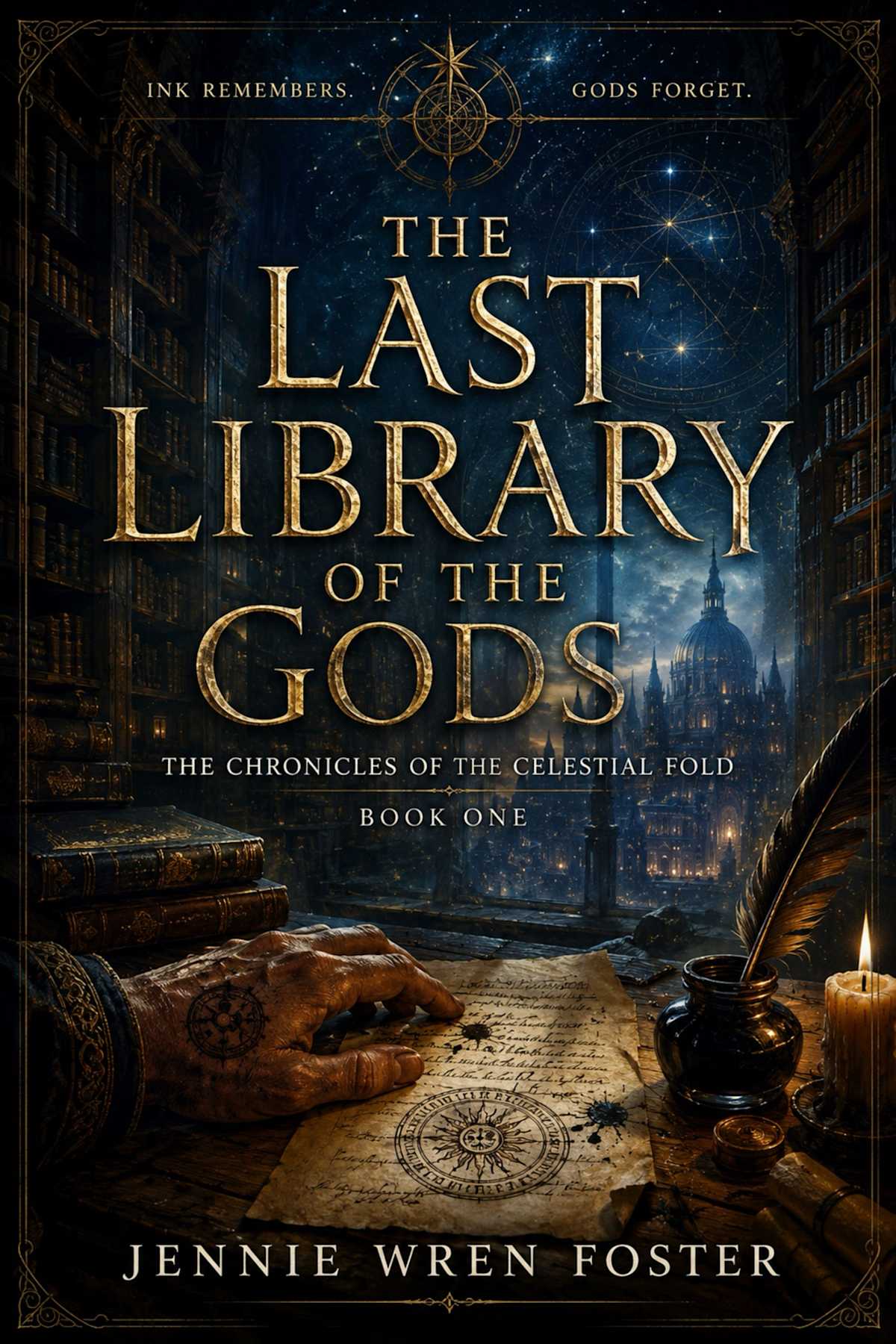
THE LAST LIBRARY OF THE GODS
Bonus Scene — The Cataloguing of Small Things
A deleted scene from the new life, for readers of the Celestial Fold. Valeriana’s point of view.
There is a particular cruelty to mornings, and no one warned me about it in three hundred years of never having one.
For three centuries I woke the way an empire wakes, all at once and already at war, the day’s threats arranged in my mind before my eyes had opened. I did not lie in beds. I rose from them. There is a difference, and I had forgotten it so completely that the first morning in the Scribe’s Cell when I simply stayed, I lay rigid under the wool blankets for the better part of an hour, certain I had forgotten something, certain a continent was burning somewhere for lack of my attention, until Elara stirred against my side and murmured, without opening her eyes, “You’re doing the thing.”
“I am not doing a thing.”
“You’re lying there like a woman waiting to be arrested.” She turned her face into my shoulder, and her breath was warm against my collarbone, and the silver of her hair caught the first grey light bleeding through the narrow window. “There’s no one coming, Val. The whole point of the new world is that no one is coming. Go back to sleep, or I’ll have you brought up on charges of disturbing the High Archivist’s rest.”
“That is not a real charge.”
“It is now. I wrote it into the bylaws yesterday while you were arguing with the masons about the reading-room shelving.”
I had, in fact, argued with the masons about the reading-room shelving. At considerable length. It is astonishing how much of an ordinary life is spent arguing about shelving, and astonishing how completely it has come to fill the place where the Godhood used to be. I had expected to grieve the throne. I do not. I had not expected to lie awake some nights cataloguing, with a fierce and ridiculous tenderness, the things I would have missed had I taken the ghost’s bargain and ruled a silent world alone. The particular weight of her arm thrown over my ribs in sleep. The smell of the brazier when the oil runs low. The sound Caelum’s quill makes three rooms away, a scratching that has become, against all sense, the sound of safety.
I am keeping a ledger again. I cannot seem to stop being a woman who keeps ledgers. But the entries have changed.
“You’re still doing it,” Elara said. “I can hear you thinking. It’s very loud.”
“I am cataloguing.”
“Cataloguing what?”
I considered lying. I had lied to this woman for the better part of our acquaintance, and she had forgiven me for it on a flight of cold stairs with the dawn coming up, and I have made myself a private vow, the only kind I make now, to spend the rest of a mortal life earning the forgiveness by never needing it again. “You,” I said. “I am cataloguing you. I find I am afraid of forgetting any of it. Three hundred years taught me that everything I love is taken eventually, and I know now that’s a lie I told myself so I’d never have to hold anything, but the knowing hasn’t reached my hands yet. My hands still think you’re going to be taken. So I am writing you down where they can’t lose you.”
She was quiet for a moment. Then she lifted her head and looked at me, and her eyes in the grey light were the soft, questioning gold I had only ever seen in this room, the gold she kept for me, and she said, “That’s the most romantic and the most alarming thing anyone has ever said to me, and I was raised by an order that considered a shared canteen a declaration of intent.”
“I contain multitudes.”
“You contain a filing system.”
“The two are not mutually exclusive.”
She laughed, and the laugh did the thing it always does, which is to undo me at a structural level, the way a single removed stone undoes a wall, and I gave up the pretense of being a woman who might at any moment be required to govern, and I reached for her.
There is no empire in this room. I have said it to her before, on the worst night, when I meant it as a bargain. I mean it differently now. There is no empire, and no crown, and no prophecy waiting to be paid, and no ghost in the walls keeping its ancient accounts. There is only the cold mountain morning held off by a guttering brazier, and the rough warm map of her against me, every scar of it I have learned by heart and go on learning, the way you reread a book you love not to discover it but to be with it. She came to me slowly, the way she does everything that matters, with her whole grave attention, and I let myself be read. That is the thing I could never have explained to the woman I was a year ago, the Empress who measured every touch for advantage. To be read. To lie still under the gaze of a person who has decided, in full knowledge of exactly what you are, to look anyway, and to stay. I had a continent kneel to me for three hundred years and never once felt seen. She traces the line of an old scar with one calloused thumb and I am laid open to the foundations, and there is nothing left to defend, and it is the safest I have ever been.
Afterward we lay tangled in the blankets that still smell of lavender and woodsmoke, the light gone from grey to a thin gold, and her fingers moved idle through my hair, and I caught one of her hands and pressed my mouth to the calluses on her palm, the ones a lifetime of holding a sword put there, the ones that will soften now, slowly, with nothing left to guard.
“I never bought you the sweater,” she said, drowsy.
“You did not.”
“Cable knit. I promised. I’m a woman of my word, when the word isn’t a treaty.” She yawned. “There’s a wool-merchant coming up from the valley settlements next week, with the first caravan since the passes opened. I’m going to buy you a truly hideous sweater, Val. The color of a bruise. You’ll hate it. You’ll wear it every day.”
“I will not wear a bruise-colored sweater.”
“You’ll wear it to argue with the masons. They’ll be so distracted by it they’ll agree to the shelving.”
“That,” I said, “is genuinely clever, and I resent that I didn’t think of it.”
She smiled against my shoulder, and the brazier popped, and three rooms away the scratching of a quill went on, steady as a heartbeat, a disgraced scribe who is no longer disgraced writing the first true history of a library that no longer keeps its secrets in blood. Somewhere below us, in the deep stone, three watchers I trust keep a door against a dark I am not yet ready to know about. And here, in a cell that was once a prison and is now the only place I have ever called home, the most powerful woman who ever lived lay still in the arms of a heretic and catalogued, with a tenderness that would have appalled her three hundred years ago, the precise and ordinary miracle of a morning with nowhere she had to be.
Entry the first, I thought, my eyes drifting closed, her heartbeat under my ear. The weight of her arm. The smell of the brazier. The sound of the quill.
I am keeping a ledger again.
I intend it to be very, very long.
Want more from the Celestial Fold? Join the reader list at www.jenniewrenfosterauthor.com for bonus scenes, early looks at The Broken Script of the Stars, and the occasional letter from the archives.