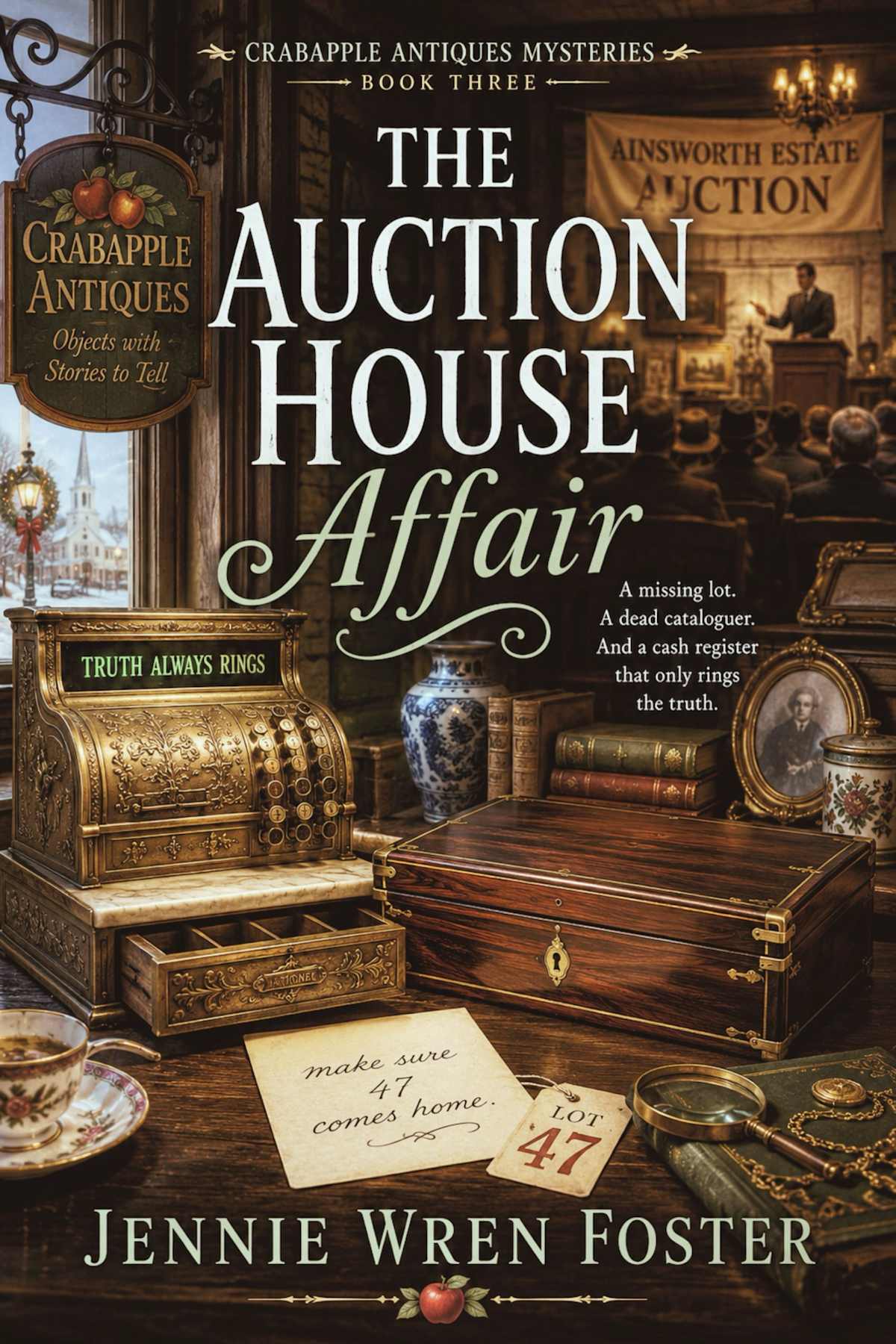
A Quiet Sale
A free bonus scene from The Auction House Affair (Crabapple Antiques Mysteries, Book Three) · Jennie Wren Foster
Kettlebrook, the week after Christmas. For everyone who wanted to know whether the register and the desk ever learned to share a counter.
The week between Christmas and the new year is the only week of the year Crabapple Antiques makes no sense as a business, which is exactly why I keep it open. Nobody buys antiques between the holidays. People return them, or they browse to get out of houses gone small with company, or they come in to tell me what their aunt’s identical piece is worth, which is always more than mine and always for reasons that would not survive an appraisal. I sell almost nothing that week. I would not trade it for June.
The snow had come at last, the real kind, the kind that makes Main Street go quiet under its own weight, and the shop was warm and low-lit and full of the particular hush of a room where several objects are pretending to be furniture. Gerald had been humming carols all morning, badly, on purpose, the way he does when he is pleased with the season. The Professor sat in the window and judged the passing sleds. The Phone had not rung in a week, which from the Phone is a kind of contentment.
The trouble, as ever, was the counter.
I had known when I let the register stay that I was housing two heads of state who did not recognize each other’s borders. The Desk had held the counter since it came to me, sorting and re-sorting, filing my receipts into orders known only to itself, and it had regarded the register’s arrival the way an old country regards a new flag planted in its harbor. Perry’s treaty had held through the autumn, drawn up on an index card and filed where Perry files things, which is to say permanently. The left half for the Desk’s sorting. The right half for the register’s judging. A line agreed upon in the grain of the wood.
Treaties are easy in wartime. It is peace that tests them.
The test arrived at half past two, in the person of Delia Marsh, who runs the yarn shop and had come in with a shoebox of her late mother’s costume jewelry to ask, as everyone asks that week, what it was worth. I told her the truth, which is that costume jewelry is worth what it meant to the person who wore it and roughly a dollar to anyone else, and Delia, who is a sensible woman, laughed and said she’d keep it then, and set the shoebox on the counter while she warmed her hands at the stove.
She set it, of course, on the line.
Half on the Desk’s side. Half on the register’s. A shoebox of a dead woman’s brooches, straddling a border two objects had spent four months not crossing, and I watched the whole diplomatic order of my shop hang on a paperboard lid.
The Desk moved first. A drawer slid, considering. It wanted to sort the box; sorting is the Desk’s love language, and a container of small mixed items is to the Desk what a fresh snowfall is to the Professor’s window, an invitation it is constitutionally unable to decline. Its writing surface gave the small shrug of a thing preparing to take an inventory.
And the register rang.
Not the scream. I had not heard the scream since the Grange, and I hoped never to hear it again outside of nightmares. This was the low figure, the appraising one, and it rang Delia’s shoebox once, gently, a modest and honest number, the worth of a thing measured in the only currency the register respects, which is not money at all but truth. It rang the box at loved, and then it went quiet, and it did not open its drawer, and it did not cross the line.
The Desk’s drawer paused.
I have spent a great deal of my life now learning to read a silence between two objects, and I will tell you that the silence that followed was not a truce holding by force. It was something else. The Desk, which sorts because it cannot bear disorder, looked at a box the register had already priced at loved, and understood, in whatever way a desk understands, that there was nothing here to put in order. A thing already known to be precious does not need filing. It needs leaving alone. And the Desk, for the first time since it came to me, left a thing alone.
The drawer slid shut. Quietly. Almost, I would swear, politely.
“Did your furniture just agree about something?” said Perry, from the doorway, stamping snow off his boots.
He had taken to coming by that week too, on the excuse of the Archive being closed and his house being cold, neither of which was quite the reason and both of which I let stand. He had a paper bag from the bakery and the particular careful cheer of a man who has decided to be somewhere and is glad he decided it.
“They agreed to disagree less,” I said. “It’s the most either of them will admit to.”
Delia collected her shoebox, thanked me for the honest disappointment, and went back out into the snow, and the shop settled again into its holiday hush, and Perry set the bakery bag on the counter, on the register’s side, and the register rang it fair, one warm cinnamon figure, and approved.
We did not talk about the autumn. We had done our talking about the autumn, in the low honest way we do it, and there is a point past which turning a hard thing over only wears it smoother without making it lighter. We talked instead about the bakery’s cinnamon and the Professor’s opinions on sleds and whether the Phone’s silence meant peace or only patience. We talked the way you talk in a warm room in a quiet week when the person across from you is the person you would have chosen to be snowed in with, which is a sentence I did not say, because we do not say those sentences, because we are keeping them, deliberately, for a year that will need them and is not this one.
But I will tell you what I noticed, because I notice things, it is the whole of what I am good at.
I noticed that when Perry reached for the cinnamon roll and I reached for the same one at the same time, neither of us apologized and neither of us pulled back, and our hands stayed a moment on the same warm paper, and the register, which prices everything, which cannot help itself, which has an opinion on the worth of every object that crosses my counter, did not ring.
It went quiet. The good quiet. The reverent one. The silence it keeps for the things too true to price, the ones it will not cheapen by putting a number in the little glass window, and I understood that my cash register had just appraised the space between my hand and Perry’s and found it, like the box of a dead woman’s brooches, like the shop, like the whole strange kept life I had inherited without knowing I was the next one, to be one of the things you do not sell.
Perry took the other cinnamon roll. I took mine. Outside the snow came down on a town that still lights its own tree by hand, and inside, on a counter divided by a treaty, two proud objects minded their halves and let a warm thing lie unpriced between them, and Gerald hummed a carol badly, on purpose, because he was pleased.
It was the quietest sale I ever made, and nothing changed hands, and it was the best afternoon of my year.
Addie and Perry’s slow burn continues, and the buyer who is quietly gathering Kettlebrook’s dangerous history comes into the light, in the next Crabapple Antiques Mystery. For word of when it opens, and for more from the shop where the furniture has opinions, come to jenniewrenfosterauthor.com.